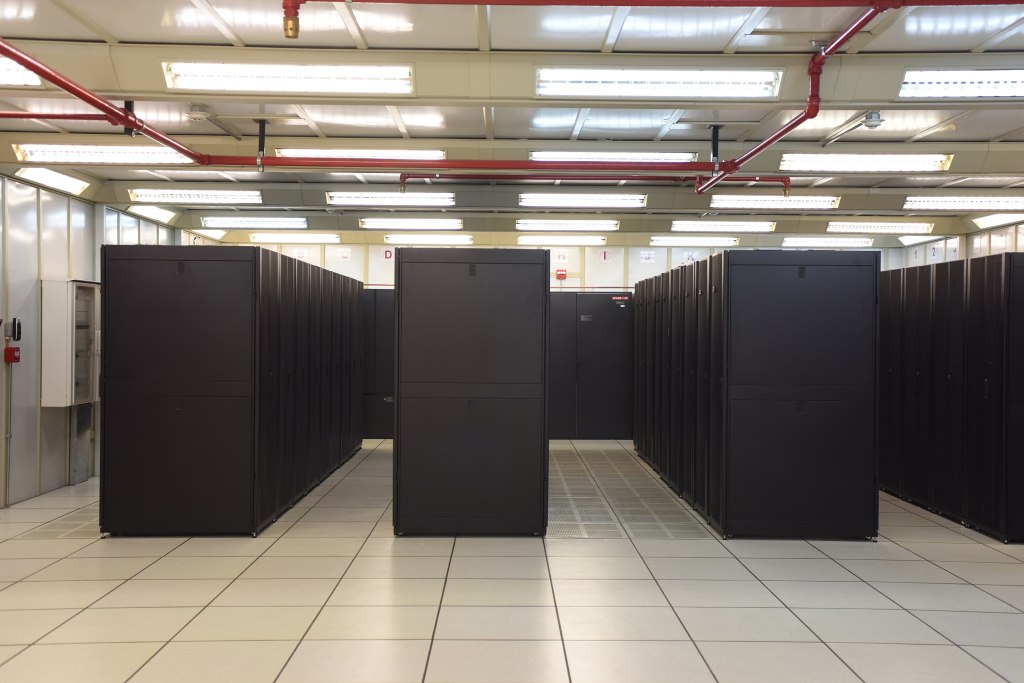
Critics say Ireland’s data centre industry has exorbitant power needs, undermines its emissions targets – and that Europe should beware.
For the most part, the protestors gathered outside the Royal Dublin Society building looked entirely what you’d expect for an anti-data centre protest: an assembly of placard-wielding, anorak-sporting, woollen hat-wearing citizens who, in their minds and those of many passers-by, were fighting the good fight for Ireland under cold and grey November skies. That is, apart from Ceara Carney. An actress on the Dublin stage, Carney had swapped the typical uniform of the environmental activist for a green cape, a cardboard broach and a crown of mistletoe and berries. Her part that day was Ériu, goddess-matron of Ireland, angered at the plundering of her country’s meagre national resources for the flimsy cause of commerce.
“With the expansion of data centres, we face blackouts or importing fracked gas, which is damaging to other communities,” Carney tells Tech Monitor from the warmer environs of her living room. “We should be using our limited energy resources carefully, or it will be normal people in Ireland that pay the price. There needs to be a pause on this [new data centres] until we have more renewable energy in Ireland than fossil fuels.”
Carney’s call and those of so many other protestors for a data centre moratorium comes at a delicate moment for the Irish economy. Recent years have seen tech giants swarm to Ireland’s low-tax marketplace like wasps to a picnic, so much so that the tiny isle perched at the razor’s edge of the North Atlantic is now the world’s third-largest market for hyperscale data centres. That, in turn, has helped support a national IT services industry worth £39bn and accounts for a whopping 21% of the country’s electricity consumption. That burden is set to rise: by 2027, it is estimated that data centre power needs will exceed those of all the households in Ireland, prompting dozens of server barns to seek separate connections to the country’s natural gas network to avoid future brownouts.
This insatiable appetite for energy, critics say, is an unacceptable threat to the country’s climate change targets. “Government policy has facilitated unchecked growth of data centres which has put our electricity system at huge risk and defies our own climate laws,” Friends of the Earth campaigner Rosi Leonard told The Irish Examiner. Former Green Party politician Eamon Ryan has been equally scathing, pointing out that the contracts Gas Networks Ireland has been signing with new data centre operators contravened established government commitments to cutting emissions.
All in all, due to the industry’s energy demand, the IEA projects Irish electricity demand will grow faster than any other European country – meaning greenhouse gases will barely fall despite renewable energy gains and possibly leading to a rise in energy imports. Ireland, therefore, faces a very clear – and escalating – data centre dilemma: how to balance the country’s clean power supply and climate change targets against what has become a vibrant and profitable addition to its wider economy.
How to balance demand and clean energy supply?
Ireland’s data centre debate is not new. Discontent at the industry’s avidity for electricity first began rumbling among environmental activists and concerned councillors in the late 2010s, eventually leading to the cancellation of an €850m data centre for Apple in Galway. Cupertino cited planning delays at the local level for its abandonment of the project, evidence of discontent with new schemes in municipal government that culminated with the imposition of a de-facto moratorium for new data centre licenses in Dublin.
 Heidi Vella